
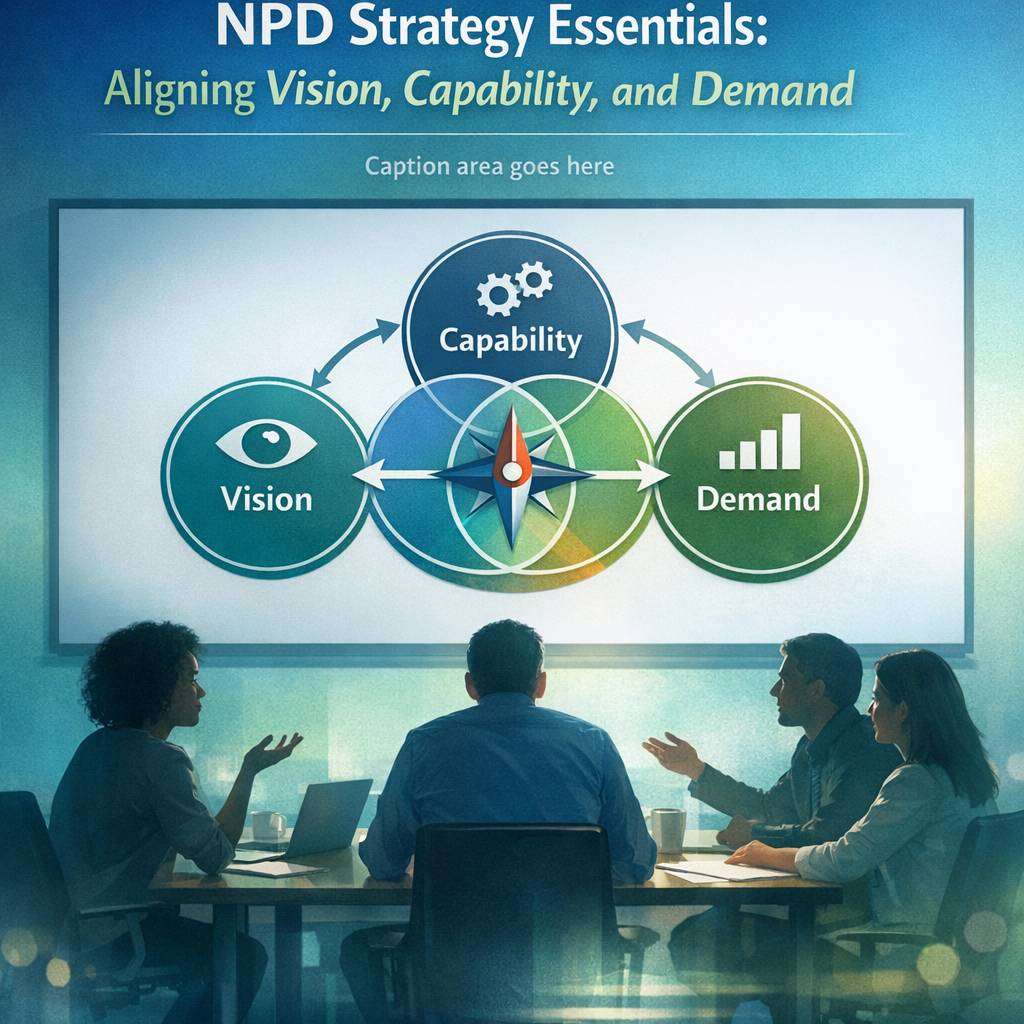
In the fast-paced landscape of today’s markets, the development of new products (NPD) is more than a one-off activity; it is a strategic discipline that integrates vision, capability, and demand. For organisations working with new product development companies or engaging in product development outsourcing, a well-structured NPD strategy helps ensure resources are deployed effectively, risks are managed, and opportunities are captured with precision. Below, I outline a practical framework that senior product leaders can adopt to align innovation ambitions with realisable capabilities and market demand.
Aligning vision with capability
The first pillar of any robust NPD strategy is a clear, testable vision. A compelling vision answers what problem the product solves, for whom, and why it matters now. Yet a vision alone is insufficient without a candid assessment of organisational capability. This involves evaluating core competencies, technology readiness, supply chain resilience, regulatory considerations, and the organisation’s appetite for risk. A pragmatic approach is to translate the vision into a set of capability requirements and then map these against existing strengths and gaps.
Key actions:
- Conduct a capability assessment that covers technology, manufacturing, design, and go-to-market excellence.
- Develop a staged product road map that links strategic milestones to capability build programmes.
- Prioritise features and attributes that deliver the greatest differentiating value while staying feasible within cost and lead-time constraints.
When consulting with npd new product development teams, it is common to see ambitious ideas falter at the feasibility stage. The remedy is to couple ambition with discipline: quantify capability gaps, set concrete build plans, and establish decision gates that pause or pivot when capabilities do not align with the evolution of the vision.
NPD and effective new product development (NPD) strategies drive market success, aligning customer insights with rapid iteration, cross-functional collaboration, and rigorous validation. Explore industry resources to elevate your process and outcomes. https://forward-npd.com/
Connecting demand with a viable product strategy
A thriving NPD process must be anchored in demand intelligence. Without a clear signal of customer need and willingness to pay, even the most technically elegant product can struggle to achieve success. Integrating demand signals early helps to de-risk development and align feature sets with customer priorities. This is particularly important for organisations working with product development outsourcing vendors or new product development consultants, who serve as accelerators rather than sole navigators of market demand.
Key actions:
- Build a demand-driven prioritisation framework that weights customer value, sizing, and strategic fit.
- Deploy iterative learning loops, including rapid prototyping, minimum viable products (MVPs), and early customer pilots.
- Establish metrics that connect demand validation to product capability investments, ensuring that each development stage reduces uncertainty.
It is natural for product development companies to encounter tension between speed-to-market and the need for robust validation. Striking the right balance requires disciplined experimentation, transparent decision criteria, and an ability to reallocate resources quickly if early feedback suggests a misalignment between market needs and planned features.
Synchronising execution with governance and risk
The third pillar focuses on execution governance and risk management. NPD is inherently multi-disciplinary, spanning strategy, design, engineering, manufacturing, and commercialisation. A coherent governance model helps ensure that projects stay on track, budgets are controlled, and learnings are captured for future cycles. For organisations working with development partners, governance also defines how collaboration is structured, how decisions are escalated, and how intellectual property is protected.
Key actions:
- Implement stage gates with objective criteria for progression, pause, or kill decisions. Gates should be informed by real-world testing, customer feedback, and capability readiness.
- Establish clear roles and accountability across internal teams and external partners, including shared KPIs and communication protocols.
- Develop a risk register that covers technical, supplier, regulatory, and market risks, with predefined mitigation actions and owners.
A common pitfall is conflating speed with agility. True agility in NPD does not mean rushing to launch; it means iterating quickly with a clear understanding of what success looks like at each stage. When checks and balances are in place, organisations can make informed bets, reallocate resources promptly, and avoid costly late-stage changes.
Practical integration: a blueprint for successful NPD strategy
To translate these pillars into action, consider a practical blueprint that organisations—be they new product development companies or client organisations engaging in product development outsourcing—can adopt:
- Vision-to-capability mapping: Start with a crisp product concept and translate it into required capabilities. Create a capability sheet that includes critical technologies, manufacturing readiness, design for manufacturability, and regulatory compliance. Identify gaps and resource plans to close them within a defined timeframe.
- Demand-led feature set: Conduct customer interviews, competitor analysis, and market sizing to generate a feature priority list. Use a scoring model to rank features by customer value, feasibility, and strategic importance. Tie this ranking to the roadmap and funding allocations.
- Learning-driven development: Embrace MVPs and pilots early in the cycle. Use real user data to validate assumptions and inform iterations. Ensure that each learning milestone triggers a decision gate—continue, pivot, or halt—based on evidence.
- Partner collaboration framework: When leveraging product development outsourcing or external consultants, codify collaboration through clear contracts, data governance, IP arrangements, and joint success metrics. Establish regular cadence for reviews, risk assessment, and knowledge transfer to internal teams.
- Performance metrics and continuous improvement: Beyond traditional KPIs like time-to-market and cost variance, track learning velocity, quality gates, and capability growth. Build a feedback loop into the organisation to refine the NPD process for future cycles.
Throughout this journey, leadership tone is critical. An NPD strategy that resonates across an organisation tends to be one that articulates a shared ambition, presents a practical path to capability attainment, and demonstrates how customer-demand insights translate into tangible product outcomes. For new product development consulting teams and product development companies alike, this alignment is the differentiator between ideas that remain on a drawing board and products that achieve sustainable commercial impact.
If you’re refining your NPD strategy, begin with a honest appraisal of where vision and capability meet, where demand signals are strongest, and where governance can make the most difference. The integration of these elements—vision, capability, and demand—creates a resilient framework for the development of new products that not only survive market tests but thrive in competitive landscapes.