
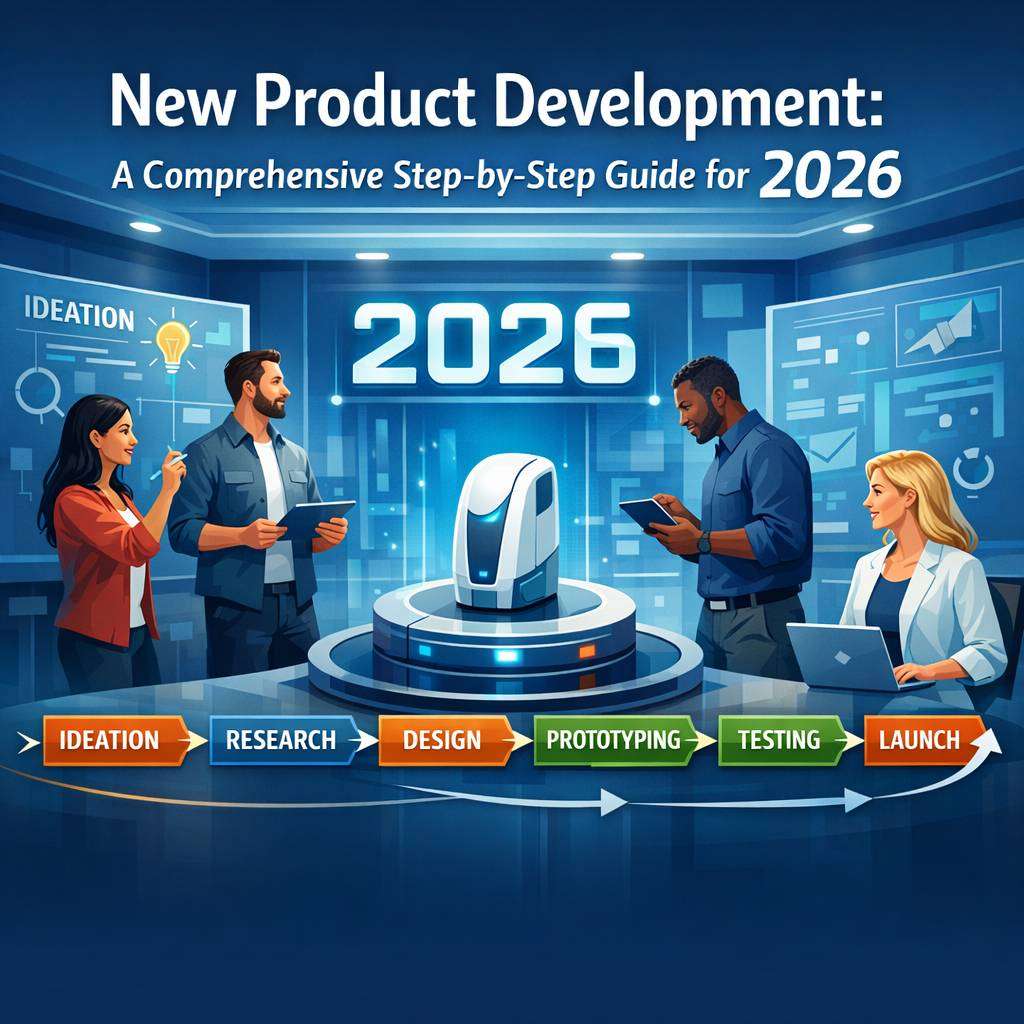
In today’s fast-paced market, steering a successful new product development (npd) initiative requires a rigorous framework, cross-functional collaboration, and a keen eye for customer value. This guide distils the essential stages and best practices for 2026, drawing on established methodologies and contemporary insights from product development consultancy and industry-leading product development companies. Whether you are a startup seeking your first scalable product or a corporate entity aiming to diversify your portfolio, the right approach to npd can accelerate value creation while mitigating risk.
A robust npd process combines strategic clarity with disciplined execution. By aligning on customer problems, market opportunity, and measurable outcomes, organisations can deliver products that resonate, differentiate, and sustain momentum in evolving marketplaces. The following sections outline a practical, step-by-step pathway that integrates core principles of product development services, product development outsourcing where appropriate, and the guidance of seasoned new product development consultants.
Step 1: Strategic Alignment and Opportunity Framing
The journey begins with a precise articulation of strategy, objectives, and criteria for success. Leaders should engage stakeholders from marketing, technology, operations, and finance to define:
- The target customer segment and underserved pain points.
- Market size, growth trajectory, and competitive landscape.
- Value proposition, core differentiators, and entry strategy.
- Financial metrics: revenue potential, cost of goods sold, and required investment.
- Risks, regulatory considerations, and key assumptions to test.
A well-scoped opportunity frame guides subsequent ideation and decision gates. Engaging a product development consultancy or a trusted npd partner during this phase can help ensure objectivity, robust problem framing, and a structured criteria set for go/no-go decisions.
FAQ: New Product Development
What is new product development (NPD)?
New product development is the process of bringing a new product to market. It typically includes idea generation, screening, concept development, business analysis, product design, testing, product launch, and post-launch assessment.
Why is NPD important for a business?
NPD helps a company stay competitive, meet changing customer needs, capture new market share, and drive growth. It also spreads risk by diversifying your product portfolio and can leverage existing capabilities and resources.
What are the main stages of the NPD process?
Common stages include:
- Idea generation
- Idea screening and evaluation
- Concept development and testing
- Business case and feasibility analysis
- Product design and development
- Prototyping and testing
- Market testing
- Commercialization and launch
- Post-launch review and iteration
How do you measure the success of a new product?
Key metrics include time-to-market, development cost, return on investment (ROI), net present value (NPV), gross margin, adoption rate, customer satisfaction, and product performance against predefined KPIs.
What role does customer research play in NPD?
Customer research validates needs, preferences, and pain points. It informs concept testing, feature prioritisation, pricing, and positioning, reducing risk and increasing the likelihood of market success.
How do you manage risk in NPD?
Use stage-gate or phase-gate processes, robust market and technical feasibility assessments, cross-functional governance, early prototyping, pilot testing, and clear exit criteria at each stage to minimise wasted effort and resources.
What is a product roadmap in NPD?
A product roadmap is a high-level visual overview of the product’s development timeline, key milestones, features, dependencies, and planned releases. It aligns teams and stakeholders on strategy and timing.
How long does a typical NPD cycle take?
Cycle duration varies by industry and product complexity. Simple consumer goods may take months; complex technology or medical devices can take years. A well-defined process with clear gates helps manage timelines and expectations.
What is the difference between incremental and disruptive NPD?
- Incremental NPD improves existing products with new features or enhancements.
- Disruptive NPD creates new markets or significantly changes how customers solve problems, often leveraging new technologies or business models.
How do you price a new product?
Pricing strategies include cost-plus pricing, value-based pricing, skimming, penetration, and dynamic pricing. Consider costs, perceived value, competitive landscape, target margins, and launch objectives.
What is minimum viable product (MVP) and its role in NPD?
An MVP is the simplest version of a product that can be released to test core assumptions with real users. It helps validate demand, gather feedback, and iterate quickly with minimal risk.
How do you handle cross-functional collaboration in NPD?
Establish clear governance, roles, and decision rights; use cross-functional teams; implement regular stage-gate reviews; maintain transparent communication; and align incentives with product outcomes.
What tools support new product development?
Common tools include:
- SWOT and market analysis frameworks
- Voice-of-the-customer (VoC) research
- Design thinking and ideation methods
- Project management and stage-gate software
- Prototyping and usability testing tools
- Financial modeling and scenario planning
How can I improve NPD without increasing costs?
Focus on early customer validation, rapid prototyping, parallel workstreams to reduce handoffs, modular product architecture, and iterative testing to catch issues before full-scale investment.
What are common NPD failures and how to avoid them?
Common failures include poor market need, vague objectives, scope creep, underestimating costs, and insufficient cross-functional alignment. Avoid by validating demand early, defining success metrics, and enforcing stage gates.
How does agility apply to NPD?
Agile approaches adapt to changing insights and feedback, enabling faster iterations, continuous learning, and closer collaboration with customers, while still respecting essential governance and milestones.
What are some best practices for successful NPD?
- Start with deep customer insight
- Define a clear set of success metrics
- Use a structured, repeatable process
- Maintain cross-functional collaboration
- Validate concepts early and often
- Build scalable, modular solutions
- Plan for go-to-market and post-launch support
- Continuously learn and improve from each project
How can I implement NPD in a small business?
Leverage lean principles: start with a validated problem, create a lean MVP, test with a small audience, iterate quickly, and reinvest learnings into subsequent development cycles.
Where can I find further resources on NPD?
Look for industry-specific guides, standards (such as ISO or quality frameworks), design thinking and lean startup literature, and case studies from your sector. Consider training or consulting to tailor NPD practices to your organisation.
Step 2: Discovery, Insight, and Concept Generation
With a clear opportunity framework, the team conducts deep customer discovery, drawing on qualitative and quantitative research. Techniques include interviews, field observations, concept testing, and early prototyping. The goal is to surface a broad set of concepts and identify those with the strongest fit to customer needs and business value.
During this stage, cross-functional collaboration is essential. Product development services teams and product development outsourcing partners can accelerate insights by providing access to specialised research capabilities, industry benchmarks, and rapid ethnography. The output is a ranked concept portfolio, each concept annotated with assumed value propositions, feasibility considerations, and initial pricing hypotheses.
Step 3: Evaluation, Selection, and Business Case Development
Concepts move into a rigorous evaluation to determine which ideas warrant investment. This involves:
- Technical feasibility assessment and risk prioritisation.
- Market viability analysis, including target pricing, elasticity, and channel considerations.
- Competitive benchmarking and differentiation mapping.
- Preliminary design and performance targets.
- Financial modelling: scenarios for revenue, margins, cash flow, and ROI.
A formal business case or NPV (net present value) model supports stakeholder alignment and governance. If outsourcing partners are engaged, this is the stage where early contracts may be drafted to secure capabilities and capacity.
Step 4: Detailed Design, Prototyping, and Validation
Selected concepts enter iterative design and prototyping cycles. Key activities include:
- Requirements decomposition into functional specs and performance criteria.
- Architecture and system design, with attention to manufacturability and supply chain implications.
- Rapid prototyping, including digital twins, MVPs, and clay models, to test form, function, and ergonomics.
- Validation testing against regulatory, safety, and quality standards.
- Customer co-creation and beta pilots to generate real-world feedback.
This phase often benefits from a mix of internal teams and external product development services providers, ensuring a balance between strategic vision and engineering rigour.
Step 5: Development, Scale-Up, and Market Preparation
With validated designs, the focus shifts to scalable production and market readiness. Activities include:
- Detailed product engineering, design for manufacturability (DFM), and supplier qualification.
- Supply chain strategy, procurement planning, and distribution readiness.
- Regulatory approvals, certifications, and quality management systems.
- Go-to-market planning: positioning, messaging, pricing architecture, and launch playbooks.
- Internal readiness: sales enablement, training, and customer support readiness.
Throughout, product development outsourcing partners can contribute advanced capabilities, such as advanced analytics, sustainability assessments, and regulatory compliance expertise, reducing time-to-market risks.
Step 6: Launch, Learn, and Lifecycle Optimisation
The launch marks the transition from project to product lifecycle management. Effective execution hinges on:
- Real-time performance tracking: customer adoption, usage patterns, and churn signals.
- Ongoing customer feedback loops and rapid iteration cycles.
- Market footprint expansion: channel diversification, partnerships, and international scaling.
- Continuous improvement: design refinements, feature prioritisation, and cost optimisation.
- Post-launch governance and portfolio review to determine next investments, retirements, or re-scoping.
New product development services teams and product development consultancy networks can support this phase by providing analytical dashboards, post-launch studies, and strategic guidance to extend product relevance.
Key considerations for 2026 and beyond
- Integrated, cross-disciplinary collaboration is essential. The most successful npd programmes synchronise insights from marketing, engineering, data science, and operations across a streamlined governance model.
- Customer-centric design remains non-negotiable. Early and frequent customer validation reduces risk and accelerates product-market fit.
- Agility combined with disciplined gating. Organisations should preserve flexibility to pivot while adhering to decision gates that protect capital and focus.
- Sustainability and responsible innovation are increasingly central. Incorporating environmental, social, and governance (ESG) considerations into design, sourcing, and lifecycle management is a differentiator.
- Leverage external expertise strategically. Product development consultants, new product development companies, and product development outsourcing arrangements can augment internal capabilities, especially for niche technologies, regulatory-heavy sectors, or rapid scale needs.
If you are exploring npd with external support, consider a partner that offers a holistic suite of product development services, from ideation and validation to prototyping and market launch. A reputable product development consultancy can provide end-to-end guidance, ensure governance discipline, and help your organisation realise a sustainable competitive advantage through well-executed new product development.
By following this step-by-step approach and maintaining a clear link between customer value and business outcomes, organisations can navigate the complexities of 2026 successfully, delivering products that not only meet market demands but also set new benchmarks in performance and usability.
New product development fuels growth by translating insights into innovative offerings that meet market needs. Teams collaborate across disciplines, iterate rapidly, and validate concepts with customers to minimize risk. Sustained focus on user value and differentiation guides strategy, enabling competitive advantage. https://forward-npd.com/